A NON PROFIT ORGANISATION
Past Projects
Angola
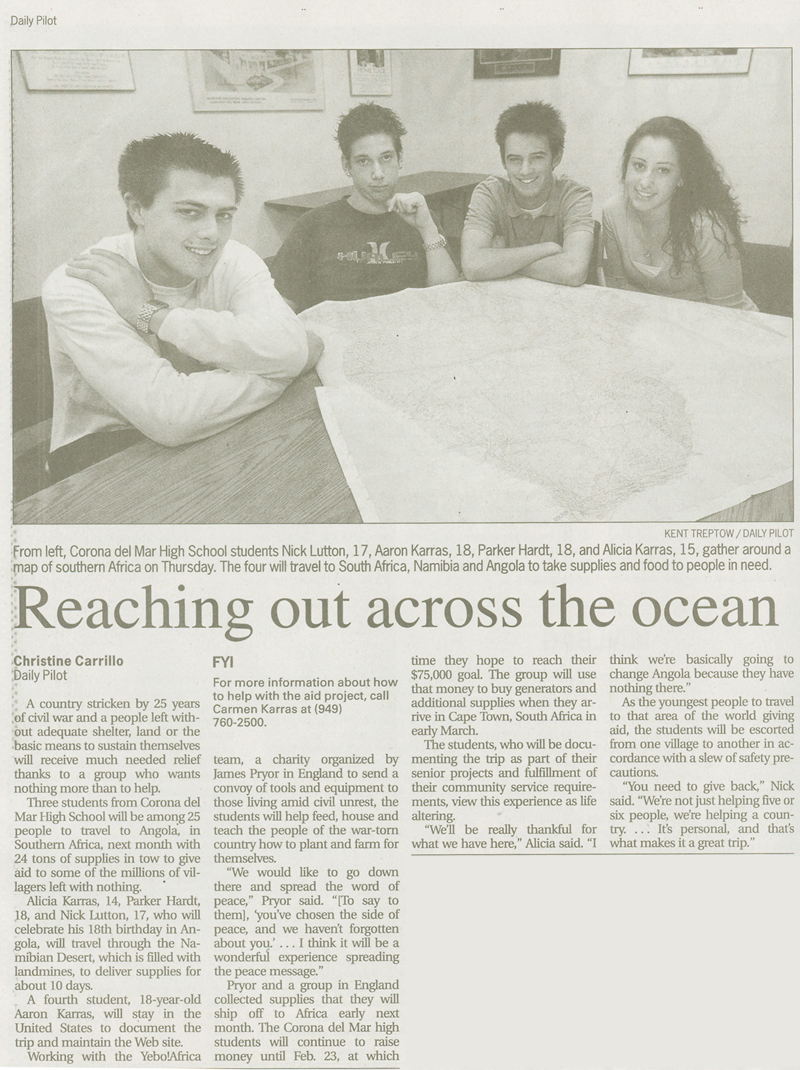
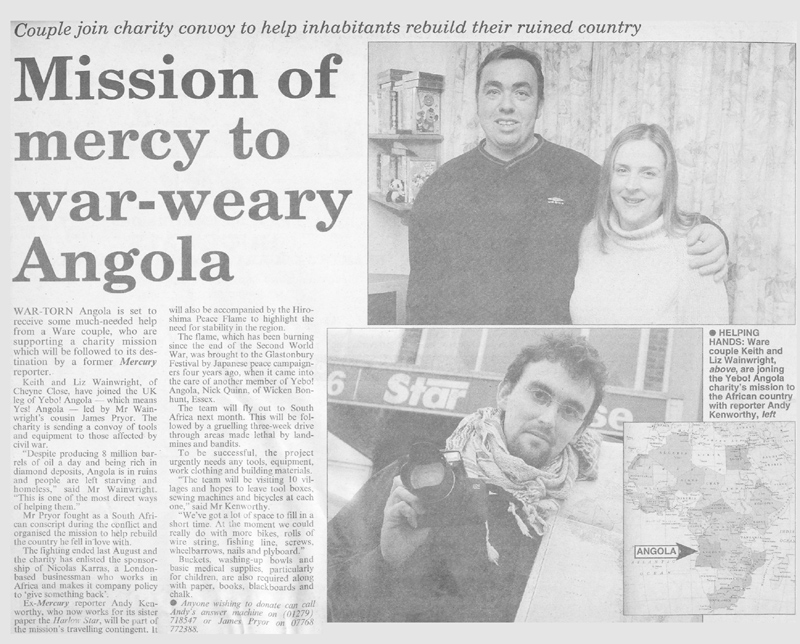
Yebo Africa embarked on its first expedition in March 2003. Seventeen volunteers (the first Westerners to reach this part of the world since the late 1980’s) took 24tons of tools, building supplies, clothes and medicines to the villages of Mucusso and Dirico in South Eastern Angola.
The team raised $50,000 in donations and sponsorship to pay for the two 20ft containers to be shipped to Cape Town, South Africa from where they were transported overland. The 3000km four-day journey through the Namibian desert and harsh African bush took them to the border post where they crossed over the Cuvango River into Angola.
“The lines of blue donation sacks have bobbed off through the superheated town, the prizes second hand bicycles are stowed away in the mud huts.
As we prepared to leave, we heard a regular clanging sounds, Metal on metal….”
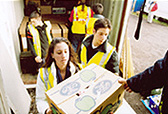

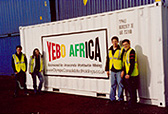
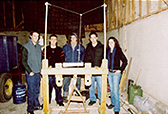
Alicia Karras, Team Leader, Parker Hardt, Nick Lutton, and Aaron Karras in the UK, Febuary 7th, 2003 leading containers for Angola. The expedition took over 6 months to organize.
Click on any of the articles below to read some of the reports on the progress



KwaZulu-Natal, South Africa
In February 2005, Yebo Africa made a trip to KwaZulu-Natal in South Africa to take much-needed donations of food, clothes and schooling equipment to a small community in Jozini. Alicia Karras (17) of Corona del Mar High School in California, who heads up Yebo Africa, co-ordinated the visit………………
“ZULUS are warriors.
They fought the colonialists, they fought the Boers and they struggled against Apartheid.
But they can’t fight HIV/AIDS on their own. History has forced the Zulus into an economic backwater that sustains the disease as much as it fails to sustain the people. In the past few years the pandemic has swept through their homeland devastating everything in its wake.
South Africa has the highest number of HIV cases in the world. More than 4.7 million people infected, about 11 per cent of the population, and the numbers are still snowballing.
In Jozini (in the Hlabisa district of KwaZulu-Natal), the area targeted by the Yebo Africa mission, one in three adults is infected with the virus, about 40,000 people. A third of the pregnant women are HIV positive, suggesting a bleak prospect for the next generation.
In the US and other rich western countries retro-viral drugs are used to slow the disease’s progress and to keep sufferers alive. In the entire Hlabisa district only 11 people can afford them.
The economic inequality which has allowed this crisis to become a catastrophe is obvious to you as you drive into this town. Jozini is perched in the mountains above the heart of some of South Africa’s most awe inspiring tourist country, next to a huge river dam. The roads which took us to our destination are dead straight flat Tarmac, punctuated with the comfortable familiarity of roadside petrol stations, burger bars and ice cold Coke. The geography of the area includes the occasional jaywalking baboon, herds of cows, people walking the continent’s interminable distances and the billboards with ex-president Nelson Mandela warning people that AIDS is everybody’s problem.
The same roads are used by the region’s millions of migrant workers. The search for work has led men further and further from their homes, which some of them only see three or four times a year. This, along with a culture of polygamy, has led many of them to resort to prostitutes or take on several sexual partners in the towns before returning to their rural wives.
This combined with a widespread ambivalence or outright hostility to the use of condoms (due to cost, religious direction, discomfort and ignorance as to their effectiveness) has hastened the spread of HIV.
This process is eradicating the most productive age group, leaving older women trying to feed huge adopted families without anyone to bring in a wage or children fending for themselves.
The area has the highest incidence of child led families with eight or more orphans. To get government support in South Africa you must have an identity card. To get a card you have to be 16. So these families get nothing.
Solutions will not be fast in coming.
The people need education, employment, but most of all they need equality.
But at the moment they welcome whatever help they can get, especially the message that they are not forgotten, that somebody cares.”
“I care and so should you too!”
Alicia Karras
james@yeboafrica.co